Install Olares on PVE with ISO image
You can install Olares directly on Proxmox Virtual Environment (PVE) using an ISO image. This guide walks you through downloading the Olares ISO, configuring PVE environment, completing the installation, and getting your Olares up and running.
Not for production use
Currently, Olares on PVE has certain limitations. We recommend using it only for development or testing purposes.
Having trouble?
If you run into any issues, submit a GitHub Issue and include your platform, installation method, and error details.
System requirements
Required specifications
- CPU: At least 4 cores. Intel or AMD x86-64 architecture required. ARM is not currently supported.
- RAM: At least 8 GB of available memory.
- Storage: At least 200 GB of available SSD storage.
SSD required
The installation will likely fail if an HDD (mechanical hard drive) is used instead of an SSD.
- Supported systems: PVE 8.2.2
Version compatibility
While these specific versions are confirmed to work, the process may still work on other versions. Adjustments may be necessary depending on your environment. If you meet any issues with these platforms, feel free to raise an issue on GitHub.
Optional hardware
A GPU is not required to install Olares, but is necessary for most AI applications. Only NVIDIA GPUs are supported.
- Architecture: Turing or newer (GTX 16xx, RTX 20xx, 30xx, 40xx, 50xx series, and later).
INFO
GPUs with older architectures are not recognized by Olares. AI applications that require GPU access will not run.
- VRAM: At least 8 GB recommended. Even on a supported GPU, limited VRAM will prevent many AI applications from running.
Not sure if your GPU is supported?
Run the following command and check the code name prefix in the output:
lspci | grep -i nvidiaExample output:
3b:00.0 VGA compatible controller: NVIDIA Corporation AD102 [GeForce RTX 4090] (rev a1)The code name prefix maps to GPU architecture as follows:
| Code name prefix | Architecture | Supported |
|---|---|---|
| GB | Blackwell | ✓ |
| AD | Ada Lovelace | ✓ |
| GA | Ampere | ✓ |
| TU | Turing | ✓ |
| GP | Pascal | ✗ |
| GM | Maxwell | ✗ |
You can also verify against the full compatible GPU list from the NVIDIA open driver repository.
GPU passthrough required
To use the GPU within Olares on PVE, you must configure GPU passthrough first. Refer to Configure GPU passthrough in PVE for instructions.
Download Olares ISO image
Download the latest official Olares ISO image.
Configure VM in PVE
To run Olares on PVE, make sure the VM is configured with the following settings. You can either apply them when creating a new VM or adjust an existing VM to match these requirements.
- OS:
ISO image: Select the official Olares ISO image you just downloaded.
- System:
BIOS: Select OVMF (UEFI).EFI Storage: Choose a storage location (for example, a local LVM or directory) to store UEFI firmware variables.Pre-Enroll keys: Uncheck the option to disable Secure Boot.
- Disks:
Disk size (GiB): At least 200GB.
- CPU:
Cores: At least 4 cores
- Memory:
Memory (MiB): At least 8GB
Below is a sample configuration for the VM hardware settings in PVE.
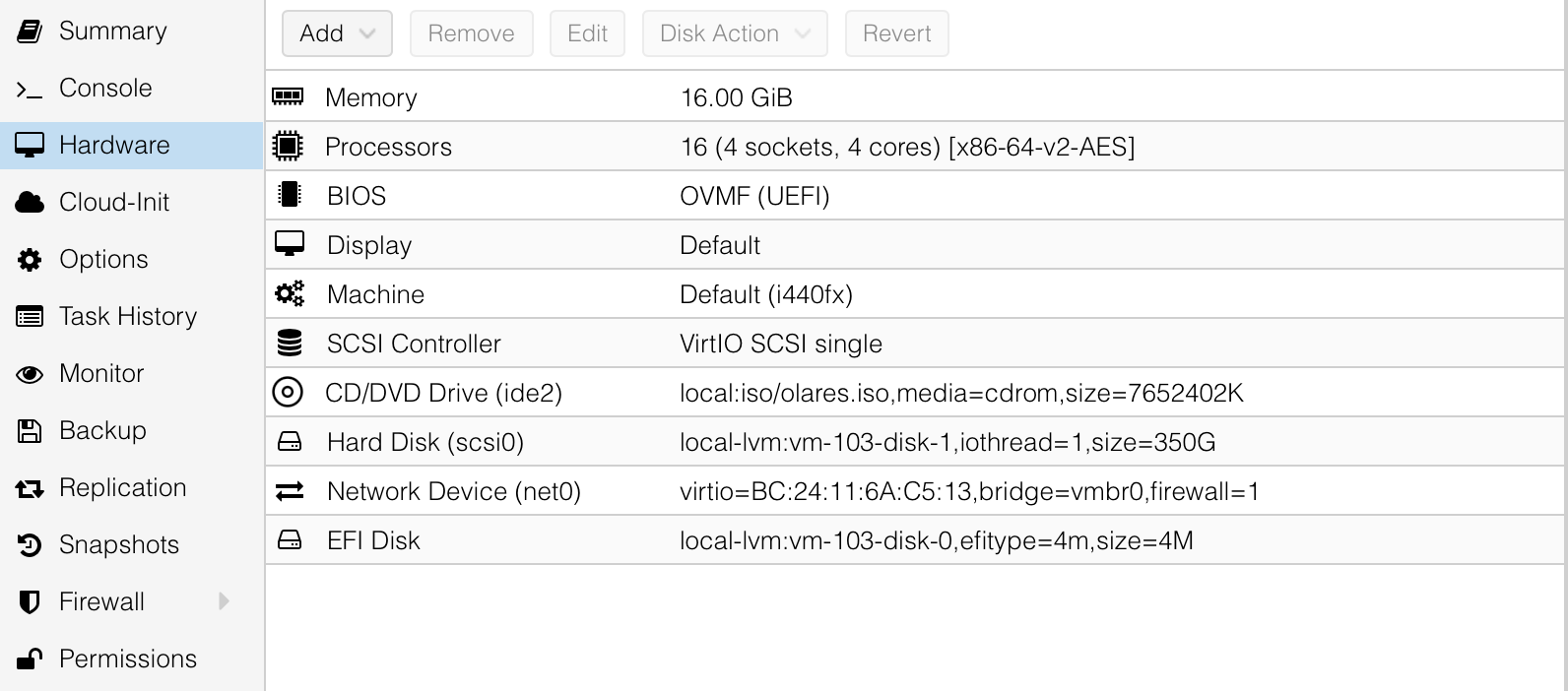
Install on PVE
Once the VM is set up, follow these steps to install the ISO on PVE.
Start the virtual machine (VM).
From the boot menu, select Install Olares to Hard Disk.
In the Olares System Installer, a list of available disks will appear (for example,
sda 200G QEMU HARDDISK). Select the first disk by typing/dev/plus its name (for example,/dev/sda). When the on-screen warning appears, just typeyesto continue.Note
During installation, warnings related to the NVIDIA graphics driver may appear. If they do, press Enter to ignore them.
Once the installation completes, you’ll see the message:
Installation completed successfully!Click Reboot in the Proxmox web interface to restart the VM.
Verify installation
After the VM restarts, it will boot into the Ubuntu system.
Log in to the Ubuntu using the default credentials:
- Username:
olares - Password:
olares
- Username:
Confirm that Olares has been installed successfully using the following command:
bashsudo olares-checkThe installation is successful if you see results like:
bash... check Olaresd: success check Containerd: success
Finish installation and activate Olares
Same network required
To avoid activation failures, ensure that both your phone and the Olares device are connected to the same network.
Open LarePass app on your phone.
On your account activation page, tap Discover nearby Olares. LarePass will list the detected Olares instances in the same network.
Select the target Olares instance from the list and tap Install now.
When the installation completes, click Activate now.
In the Select a reverse proxy dialog, select a node that is closer to your geographical location. The installer will then configure HTTPs certificate and DNS for Olares.
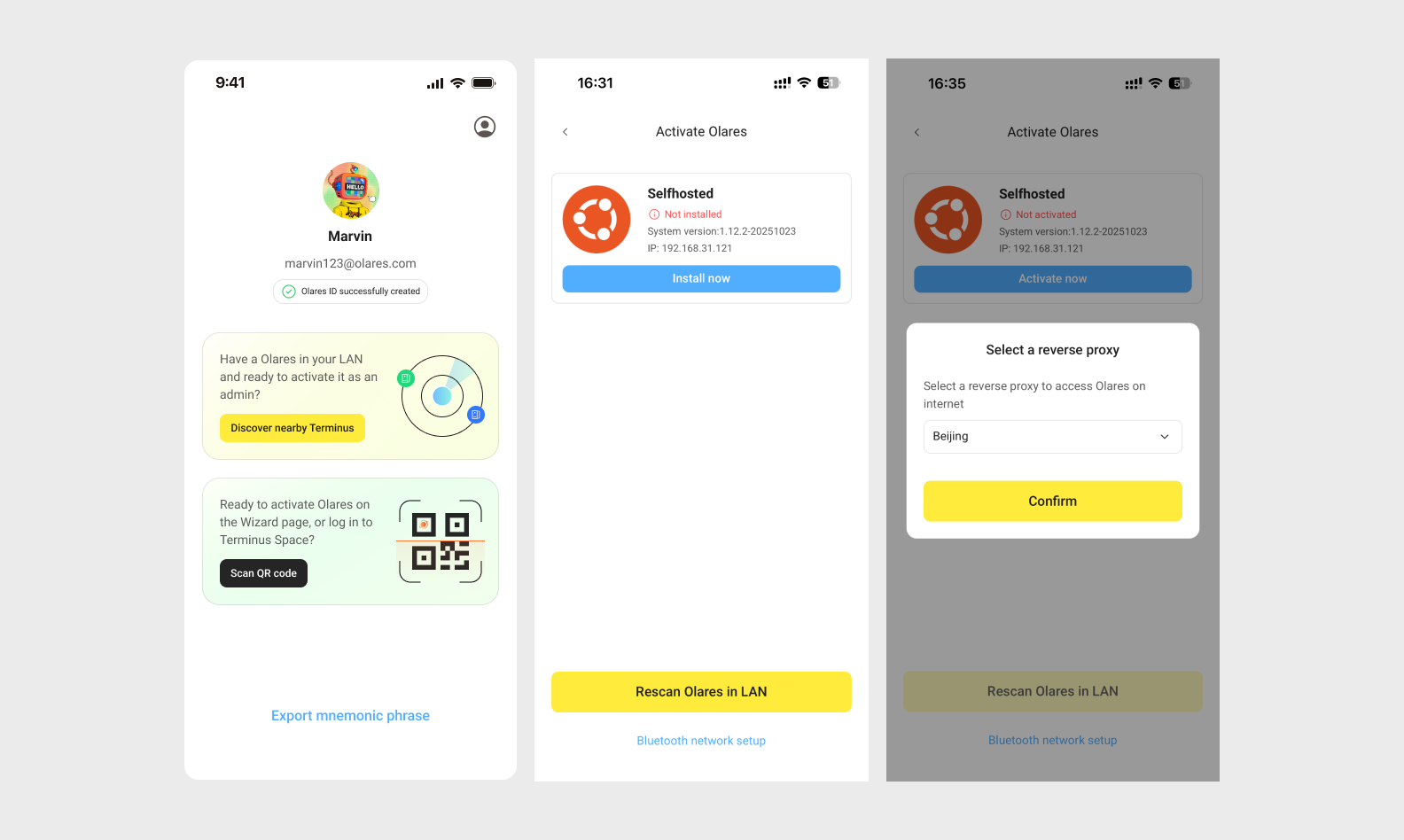
Note
- You can change this setting later on the Change reverse proxy page in Olares.
- If your Olares device is connected to a public IP network, this step will be skipped automatically.
Follow the on-screen instructions to set the login password for Olares, then tap Complete.
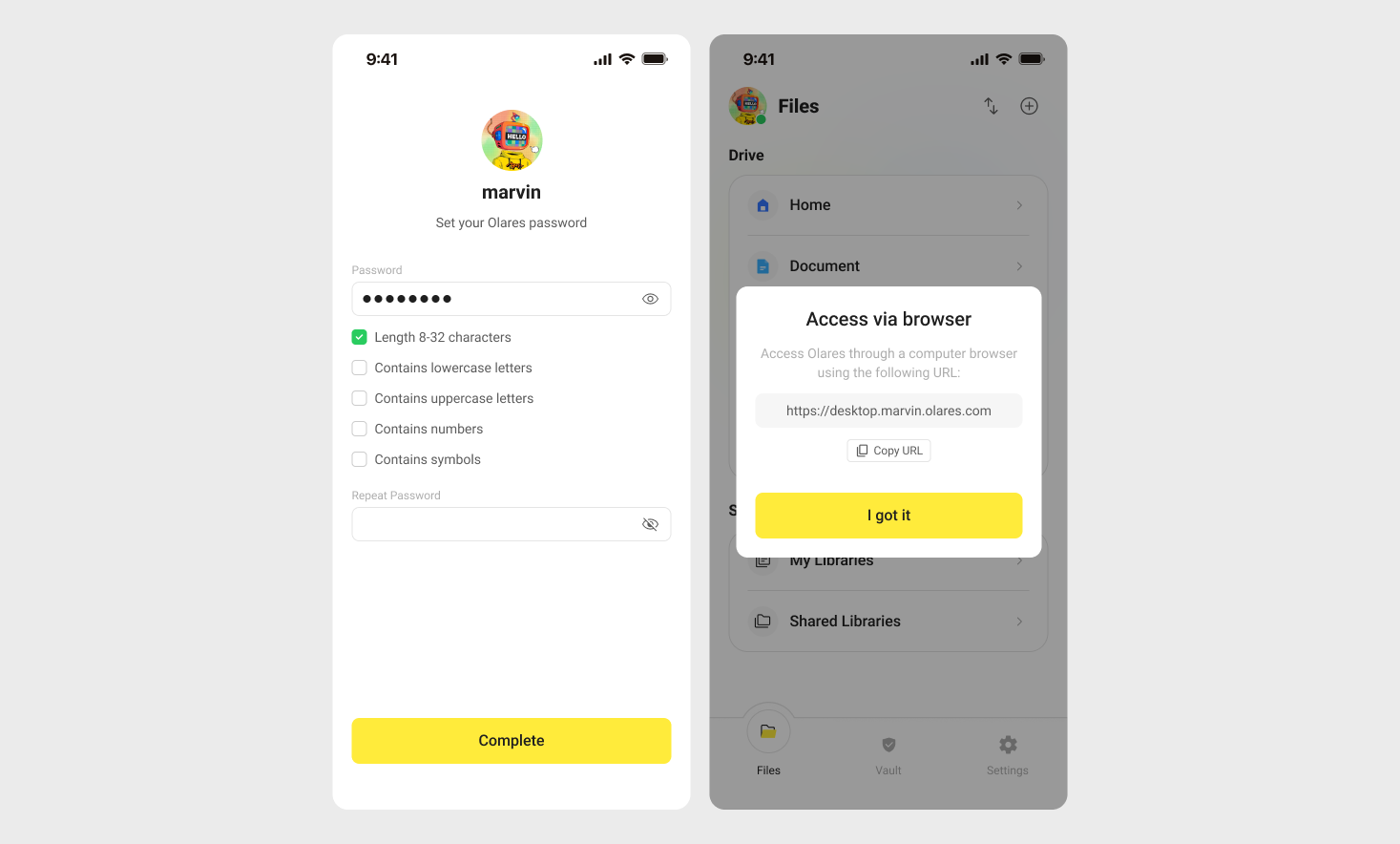
Once activation is complete, LarePass will display the desktop address of your Olares device, such as https://desktop.marvin123.olares.com.
Log in to Olares
Open the Olares desktop address in your browser, and press any key to continue.
On the login page, enter your Olares login password.

You will be prompted to complete two-factor verification. You can confirm the login on LarePass, or manually enter the 6-digit verification code.
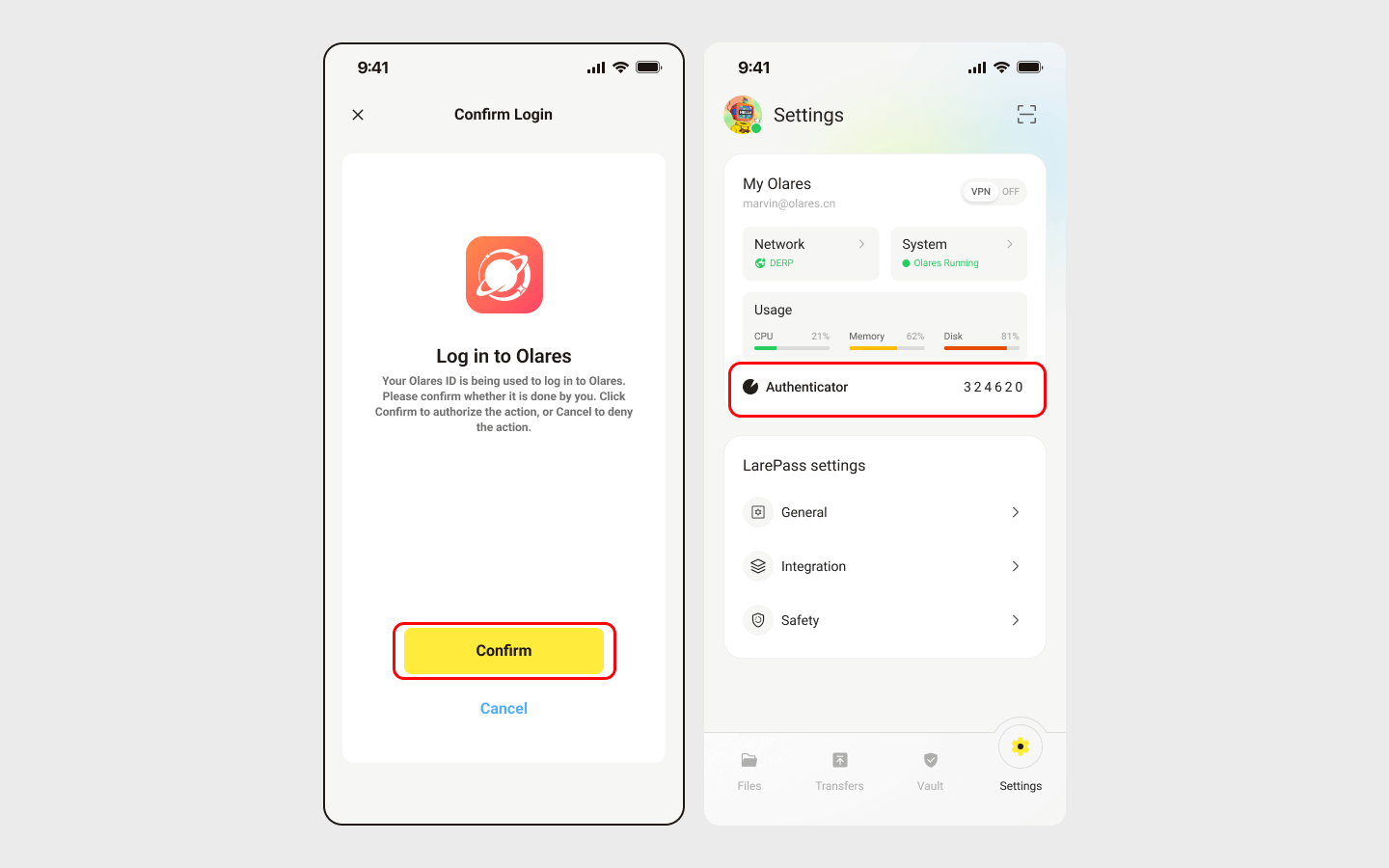
INFO
The verification code is time-sensitive. Ensure you enter it before it expires.
Once you've logged in, you'll be directed to the Olares desktop.🎉
Next step: Protect your Olares ID
You're almost ready to start using Olares! Before diving in, it's crucial to ensure your Olares ID is securely backed up. Without this step, you won't be able to recover Olares ID if needed.